


Pat Morita: The Life Beyond Mr. Miyagi
Pat Morita became a familiar presence to generations of moviegoers, often long before audiences knew the name of the actor behind the face. For millions, he became inseparable from one unforgettable character: Mr. Miyagi.
Audiences remember the quiet voice, patient manner, bonsai trees, old car and lessons that appeared to be about karate but carried something deeper about life.
“Wax on. Wax off.”
For many viewers, that is where the story of Pat Morita begins.
His life, however, began long before Mr. Miyagi entered popular culture. It also extended far beyond the character that made him internationally recognizable.
In 2021, the World Music & Independent Film Festival, or WMIFF, presented More Than Miyagi: The Pat Morita Story. The documentary invited audiences to look beyond the role most closely associated with Morita and reconsider the life behind it. That year, the film received Best Feature Documentary at WMIFF.
For me, that recognition carried a special meaning.
As the founder of WMIFF, I had spent years watching filmmakers bring their stories to the festival. This documentary felt different. It was not simply revisiting an actor audiences already knew. It was asking us to see the person behind the character.
I also remember WMIFF honoring Morita’s lifetime contribution to film and television during that year’s gala. Pat could not be there. He had died more than 15 years earlier.
Yet his presence remained through the body of work he left behind.
Pat Morita Before the World Knew Mr. Miyagi

Pat Morita was born Noriyuki Morita on June 28, 1932, in Isleton, California.
His childhood was far removed from the warmth and humor audiences would later associate with him. Morita endured serious illness at an early age, including spinal tuberculosis, and spent years undergoing medical treatment.
Those experiences became part of a life shaped by hardship, resilience and the realities of growing up Japanese American in the United States.
Years before Hollywood recognized him as a dramatic actor, Morita found his way to comedy.
Performing stand-up under the stage name “The Hip Nip,” he developed a strong sense of timing and an instinct for reading an audience. Those skills remained evident throughout his acting career.
That part of his story has always interested me.
Millions would eventually remember Morita for stillness, restraint and quiet wisdom. His professional roots, however, were in comedy.
Stand-up taught him when to speak, when to pause and how a small gesture could produce a strong reaction. Those instincts later became part of what made his dramatic performances so effective.
Building a Career in Hollywood

Morita’s first credited film appearance came in Thoroughly Modern Millie in 1967.
More screen work followed, including The Shakiest Gun in the West in 1968 and Evil Roy Slade in 1972. Television also became an important part of his career, with appearances on programs such as Sanford and Son and M*A*S*H.
Success did not arrive through a single breakthrough.
Morita built his career one opportunity at a time, moving between film, television and comedy while establishing himself as a dependable and versatile performer.
Years of experience came before audiences ever heard the name Mr. Miyagi.
Arnold and Pat Morita’s Television Breakthrough
Before The Karate Kid, many television viewers already knew Morita as Arnold Takahashi on Happy Days.
His appearances on the popular sitcom during the 1970s and early 1980s gave him a recognizable place in American television.
That role matters when looking at his career as a whole. Morita was not an unknown performer who suddenly stepped onto a movie set and became famous overnight.
By then, he had already spent years developing his craft.
Television continued to provide significant opportunities. In 1987, Morita starred in the police drama Ohara as Detective Lieutenant Ohara.
His television work also included appearances in programs such as Magnum, P.I., Murder, She Wrote, Baywatch and The Hughleys.
A substantial career was already underway long before anyone asked him to say, “Daniel-san.”
The Role That Changed Pat Morita’s Career

Then came 1984.
The Karate Kid introduced audiences around the world to Mr. Miyagi. The humble maintenance man became a mentor, teacher and father figure to Daniel LaRusso, played by Ralph Macchio.
On paper, the character might have appeared simple.
In Morita’s hands, Miyagi became unforgettable.
Rather than relying on long speeches, the character taught through work, repetition, discipline and silence. Some lessons arrived without an immediate explanation, allowing Daniel to discover their meaning through experience.
Morita gave Miyagi humor without reducing him to caricature. He gave the character authority without aggression and wisdom without making him feel distant.
That balance became one of the defining qualities of the performance.
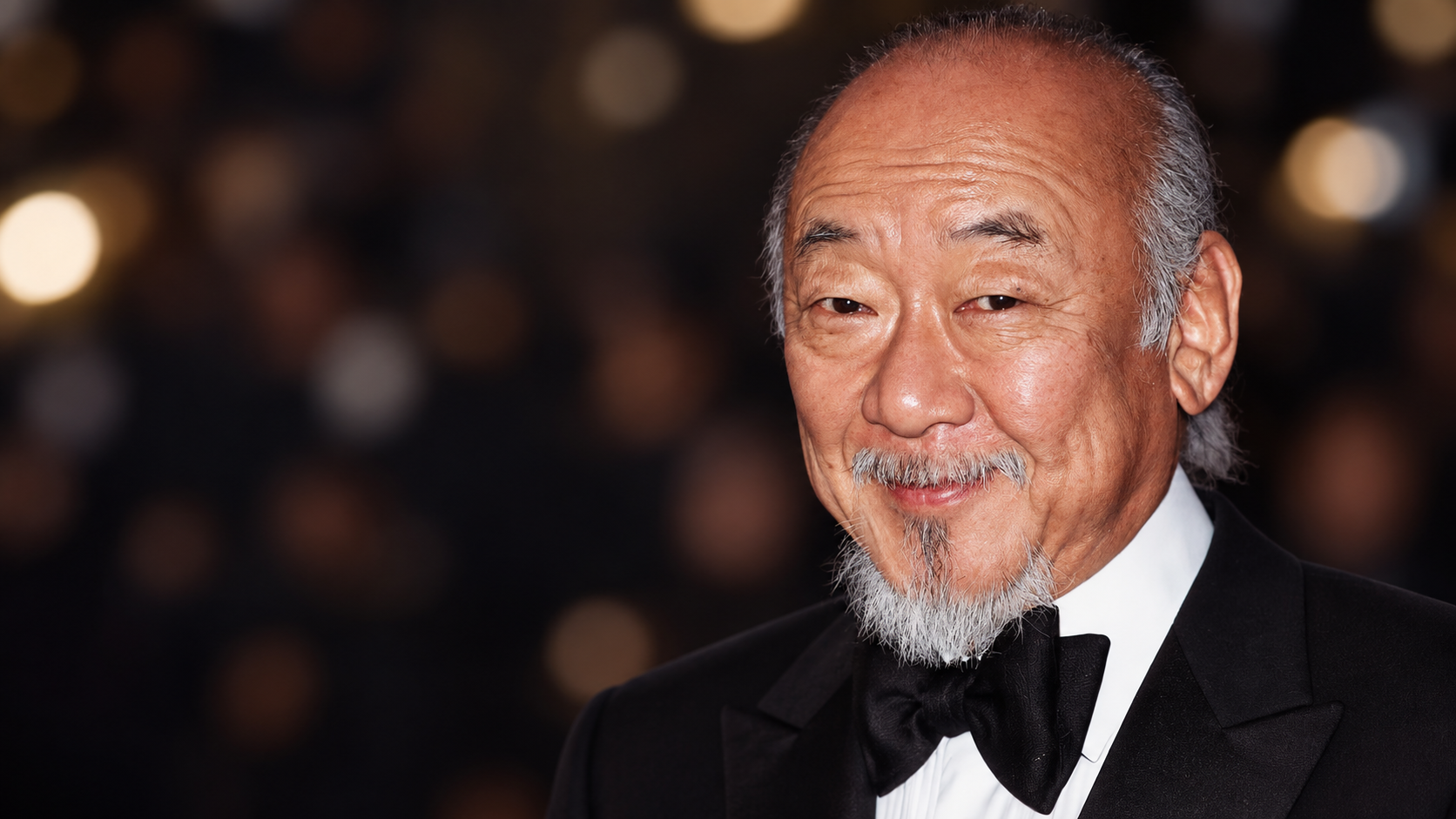
His work in The Karate Kid earned Morita an Academy Award nomination for Best Supporting Actor. His extensive screen career is also documented in Pat Morita’s IMDb filmography.
Morita also received Golden Globe recognition during his career, including nominations connected with The Karate Kid and the television film Amos.
For a Japanese American actor who had spent years navigating Hollywood, that recognition marked an important point in a career built steadily over time.
Morita had moved from stand-up comedy and supporting television roles to a performance that would become central to his public legacy.
His journey was far from finished.
The Miyagi Years
Morita returned to the role in The Karate Kid Part II in 1986 and The Karate Kid Part III in 1989.
In 1994, he played Miyagi once more opposite Hilary Swank in The Next Karate Kid.
His association with the franchise also extended to The Karate Kid animated television series, where he appeared in live-action introductions.
Across those projects, Mr. Miyagi grew beyond the boundaries of a single film.
The character became part of popular culture.
Creating a role with that kind of lasting recognition is a remarkable achievement. It can also present an unusual challenge for an actor.
When a character becomes larger than the performer, audiences can begin to lose sight of the person who created it.
That is why Morita’s broader career deserves to be remembered.
A Career Beyond Mr. Miyagi
Morita continued working well beyond the Karate Kid franchise.
His film career stretched across decades and included titles such as Captive Hearts, Honeymoon in Vegas and Even Cowgirls Get the Blues.
Another generation encountered his work through animation.
In Disney’s Mulan in 1998, Morita voiced the Emperor of China. He brought dignity, authority and warmth to the character before returning to the role in Mulan II.
The performance offers another reminder of his range.
A viewer could grow up knowing Morita’s voice without immediately realizing that it belonged to the same performer who played Mr. Miyagi.
His television career was equally broad.
From Sanford and Son and M*A*S*H to Happy Days, Mr. T and Tina, Ohara, Murder, She Wrote, Baywatch and The Hughleys, Morita worked across different eras of American television.
These titles are more than entries on a résumé. Together, they reflect the longevity of a performer who continued taking on new work throughout his career.
Pat Morita was never simply a one-role actor.
He was a working performer whose career stretched across generations.
Why More Than Miyagi Matters to Pat Morita’s Story
That larger story is what made More Than Miyagi: The Pat Morita Story so meaningful.
Directed by Kevin Derek, the documentary looks beyond the familiar image of Mr. Miyagi and explores the life of the performer who created him.
Morita’s childhood, career, experiences with discrimination, personal struggles and professional accomplishments reveal a story far more complex than the character most closely associated with his name.
The title captures that purpose with remarkable simplicity:
More Than Miyagi.
Audiences were being asked to remember that behind the fictional mentor was a real person. His life contained illness, struggle, humor, ambition, disappointment, perseverance and success.
WMIFF recognized the film as Best Feature Documentary in 2021.
For me, the festival’s remembrance of Morita carried an additional significance.
Presenting lifetime recognition to someone who is no longer there to receive it changes the nature of the moment. The ceremony becomes less about applause and more about remembrance.
It becomes a way of saying that the work remains, the contribution matters and the person behind the characters has not been forgotten.
The Lasting Legacy of Pat Morita
Pat Morita died on November 24, 2005, at the age of 73.
Death, however, does not necessarily end an actor’s relationship with an audience.
Sometimes a performance begins another life after the performer is gone.
A child may watch The Karate Kid for the first time decades after its release. Someone else may discover an old episode of Happy Days. Another viewer might hear the Emperor in Mulan without realizing that the voice belongs to the same actor they know as Mr. Miyagi.
Years later, that audience may encounter More Than Miyagi and discover an entire life behind the familiar character.
That is one of the lasting values of documentary filmmaking.
It gives us an opportunity to look again.
Remembering the Man Behind Mr. Miyagi
When we talk about Pat Morita today, it would be easy to begin and end with Mr. Miyagi.
I do not think we should.
Mr. Miyagi was unforgettable, but Pat Morita was more complex, more accomplished and more human than any single character could represent.
Across his life, he became a comedian, television actor, film performer, voice actor and writer. Away from the screen, he was also a husband and father who experienced hardship alongside professional success.
For decades, Morita worked in an entertainment industry where opportunities for Asian American performers were often limited.
He continued building a career that eventually produced a character loved by audiences around the world.
That is a remarkable legacy.
Looking back on WMIFF’s decision to recognize More Than Miyagi, I am reminded that film festivals are not only places where new voices are discovered.
They can also become places where earlier voices are remembered.
In 2021, More Than Miyagi: The Pat Morita Story brought Morita’s life before our festival audience and received Best Feature Documentary.
I also remember that year’s gala as an opportunity to recognize his lifetime contribution.
Not every moment of an event survives permanently in an online archive. Photographs, official records and personal memories can preserve different parts of the same history.
What has remained with me is what that evening represented.
The recognition was not only about Mr. Miyagi.
It was about Pat Morita — the performer, the person and the life behind one of cinema’s most enduring characters.
Perhaps that is the most fitting lesson of all.
— June Daguiso
Discover more biographies, profiles and human-interest stories from Global People Magazine.
Pat Morita at a Glance
| Year | Film or Television Work | Notable Credit |
|---|---|---|
| 1967 | Thoroughly Modern Millie | Early credited film appearance |
| 1968 | The Shakiest Gun in the West | Film |
| 1972 | Evil Roy Slade | Film |
| 1972 | Sanford and Son | Television |
| 1970s | M*A*S*H | Television |
| 1974–1983 | Happy Days | Arnold Takahashi |
| 1984 | The Karate Kid | Mr. Miyagi |
| 1986 | The Karate Kid Part II | Mr. Miyagi |
| 1987 | Ohara | Detective Lieutenant Ohara |
| 1987 | Captive Hearts | Film |
| 1989 | The Karate Kid Part III | Mr. Miyagi |
| 1992 | Honeymoon in Vegas | Film |
| 1993 | Even Cowgirls Get the Blues | Film |
| 1994 | The Next Karate Kid | Mr. Miyagi |
| 1998 | Mulan | Emperor of China, voice |
| 1998 onward | The Hughleys | Television |
| 2004 | Mulan II | Emperor of China, voice |
| 2021 | More Than Miyagi: The Pat Morita Story | Documentary subject |